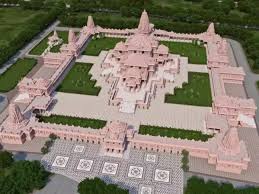
Ayodhya is one of the major holy cities of Hinduism - the world's 3rd largest religion. It has a central role in the ancient Indian epic, the Ramayana, whose protagonist Lord Rama is God incarnated on Earth as the prince of Ayodhya. The epic describes Lord Rama's 14 year exile, his victory over evil and his grand return with his wife Sita to Ayodhya to become king. This return to Ayodhya is celebrated as Diwali, the leading festival of hundreds of millions of Hindus world-wide. Consequently Lord Rama's reign over Ayodhya and its surroundings, called Ram Rajya, is the epitome of good governance and moral society in the Hindu tradition.
The story of Rama has transcended into a great inspirational story and parable for children and adults around the world. Ayodhya has come to symbolise inner peace, joy and spiritual upliftment.
Ayodhya's history has also been marked by Hindu-Muslim disputes about a temple and mosque. In 1527, the Mughal Emperor Babur had a temple destroyed and a mosque constructed at the site in Ayodhya traditionally associated with the birth of Rama. Since then the Babri Mosque became a focal point of grievances and disputes. The mosque was ultimately destroyed by demonstrators in 1992. Following the destruction, there were large riots in Gujarat and terrorist acts (including the Godhra train massacre, which triggered the Gujarat riots, and the 2005 Ram Janmabhoomi attack in Ayodhya).
-
-

- Breakfast
Included
-
-
- Dinner
Included
- 02 DBL Rooms
- 02 Nights accommodation in Ayodhya with breakfast and dinner
- All transfers and sightseeing as per itinerary in vehicle by private basis
- Road taxes, parking fees, fuel charges, interstate taxes and toll taxes
- GST unless specifically mentioned in the rates
- All personal expenses like tips, laundry, telephone calls, alcoholic beverages, camera/video fees at monuments, medical expenses, airport departure tax, etc.
- Anything not mentioned under package inclusions.
- Entrance fees at all monuments and sightseeing spots
- No refund is available for No Sho
- Cost incidental to any change in the itinerary/stay on account of flight cancellation delay due to bad weather or any other reason given by the airline ill health road blocks and/or any factors beyond reasonable control. No refund will be available for unutilized services.
- No refund for No Show at any service
- Airfare if not mentioned in the itinerary
- Room allocation (Twin bed / Double bed) is at the discretion of the hotel.
- Standard check-in time is 1500 Hrs & check-out time is 1100 Hrs.
- Number of meals are always corresponding to the number of nights booked. Breakfast is not provided on the day of arrival.
- Early check-in and late check-out are subject to availablity. Extra charges if any, have to be settled directly by the guest.
- Either rollaway bed or mattress shall be provided for extra adult / child in hotels.
- Guests are requested to take care of their personal belongings and avoid leaving them unattended.
- Cost of additional services availed by the guest which are not part of our package have to be settled directly at the hotel.
- The hotels are suggested on the basis of feedback taken from our customers. Still we request you check hotel website and other sources for reviews. We will not be responsible for any deficiency of services by hotel.
- Suggested hotels are subject to availability at the time of booking. In case the same are not available, then the best Similar* category will be provided.
- Transfers and sightseeing tours are on SIC (seat in coach) / shared basis. Unless private transfers / tours are specifically mentioned.
- The vehicle used (A/C or Non A/C) is available for point to point services only and is not at disposal. Guests are requested to strictly follow the timings in the program.
- It is mandatory to carry age proof of children (02 to 11 yrs) and infant (below 02 yrs). Child above 11 years shall be considered an adult.
- Photo id of every person is mandatory for check-in.
- 50% advance to be paid at the time of booking.
- Air fare is calculated at the time of proposal creation and is subject to change at the time of actual booking.
- 100% payment is to be made for domestic packages before 14 days of departure date.
- 100% payment is to be made for international packages before 30 days of departure date.
- In case of cancellation, standard cancellation policy will be applicable unless specified differently
General Cancellation Policy:
- If cancellation is made any time not less than 45 days prior to departure, INR 5,000 (per person) shall be deducted.
- If cancellation is made 45 to 30 days prior to departure, 50% of the tour cost or INR 5,000 per person, which ever is higher shall be deducted.
- If cancellation is made 30 to 15 days prior to departure, 75% of the tour cost shall be deducted.
- If cancellation is made within 15 days prior to departure, total tour cost will be non-refundable
Note: Many bookings are non-refundable once booked. Be careful before making any reservations.